Friday, 29 July 2011

Hedge-ing my bets

Hello,

Still no A13.  My own fault for not picking up the glue gun when at Mike's.  Doh!  Thankfully I have that back now.

However, it has been somewhat overtaken by events.  Those who follow me on Facebook/Google+ or whom frequent the Brighton Warlords or Flames of War Forum will know that we've just announced a Flames of War, late war, 1750pts axis vs allies tournament in mid January.

The last tournament we ran spurred me on to create enough road for 16 tables, two winter tables, about a square meter of cornfields and more cabbage patches than probably existed in Northern France.  It made for some pretty tables but it also pretty much burnt me out on terrain making until about now.
P1000187
"Welcome!  Beware of 88's"
P1000189
You can't see it, but there's an M-10 lurking in this photo ready to mess that Sherman up.
Hill2
King of the Hill - FoW style
One of the projects that didn't make it off the drawing board was a simple to make hedge.  Linear terrain can play a big part of making a convincing and fun to play on board.  Recce can exploit it for cautious movement, infantry get some safety from HMG and controlling the high ground becomes even more important than normal.  The BW club has a shoebox full of Ironclad Miniatures Bocage which is enough for a few good size fields on one table, but that's about it.

Now, one of the first bits of non desert terrain I made was a massive hill complex, covered in trees.  The trees were made from scouring pads stuck on a BBQ bamboo skewer.  Spray black and drybrushed green, they were surprsingly effective.  Before the tournament I then revisited the concept and skipped the black undercoat. This wasn't quite as pretty but could be made quickly and still worked when mixed in with the older ones.
tree1
"Scour that tree line, men!"
So, based on that, it seemed that a scouring pad hedge would be a good bet.  I made a test piece by gluing two strips of scouring pad together and then sticking that to a strip of MDF.  This basically gave me something that looked like two badly mauled bots of scouring pad stuck to a piece of MDF...
DSC04865
Okay, maybe I'm a little harsh...
P1000030
How not to clean tracks...
At about this point in the process, and somewhat in a strop, I decided to ditch the project and pretty much haven't made any terrain since.

Skip forward a few years and whilst flicking through the stats for my Blog I came across this tutorial over at "Another Slight Diversion" that is sending me some traffic.  This was pretty much the missing link in the development of the hedge and I rushed to try it out to see if it would scale up.  I had the dregs of a can of Leather Brown and found some flock in my basing drawer.  Now, I can't remember the last time I used flock, but apparently I'm a pack rat and never throw things away.

After following the steps on the blog, I was left with this
P1010754
Over the 'edge lads!
A significant improvement!  My next thoughts were on how to scale this up so that I could produce about 32ft of it!  Driving cost down would be the main aim as using Army Painter brown and matt varnish would get pricey.  Instead, I plan to use Plasti-kote spray paint from the local B@Q at about £2 a can cheaper!  I have previously used the stuff for the winter terrain bases and to blue shade the white sheets and it seemed to do the trick for terrain making purposes.
P1000191
Some of said winter stuff.

The next thought was to make the hedge so that it didn't need junction pieces.  Basically, create a shape for the base that allowed the hedge to be butted up to another piece in any way that would be required.  Here's a sketch:

universal_base1
Behold the awesome power of MS Paint!
I cut the end of the prototype to match, you can see it on the right of the "over the 'edge" photo.

The base could also be used for wall sections.  I plan to knock up about 16ft of wall sections using foam card that I retrieved from the skip at work.  It's slightly warped, but given the short sections required I think it wont be noticeable.  This is my first proof of concept.
P1010749
Yeah, Dingo's are that low.
I want to spruce it up a bit by adding posts at one and the centre point so that when the walls are combined it looks like an evenly spaced distribution of posts.  The posts would be made from high density polyester foam, cut into a column with a hot wire cutter.  The whole lot will then be covered in textured masonry paint, washed with thinned down decking stain and dry brushed to resemble a weathered, rendered, white washed wall that one could reasonably expect to run into all over Europe (alternatively, I'll scribe a brick/drystone texture into the foam).  I may even use cardboard to add a slate tile cap.  

So, that's the start of a plan.  Hopefully over the next couple of months I'll be able to bash that out, with help from the rest of the Brighton Warlords FoW community, and start looking at some extra projects to round out the tables (embanked and cobbled roads, irrigation ditches, a few ridge lines).

Times ticking...

As a final note, updates may be sporadic again until September.  I'm helping the rest of the family with a few building projects so free time may be at a premium!

Sunday, 17 July 2011

Hear me talk nonsense!

No real update this week.  Will hopefully be starting the A13 this week.

In the meantime, the All Along the Watchtower podcast asked me to come along and talk Flames of War whilst Matt got his move on.  

During the pod cast we talk about "Hellfire and Back", the finer points of Sherman tank design (in response to the rather tasty Plastic Soldier Company) and the SMLE.  There's also some non-flames stuff too!

Let's talk about the Sherman kits.  I was worried about monopolizing the whole podcast on a subject most people don't care about so I want to use this blog post to cover some of the minute detail of the Sherman and how the kits relate to it

Firstly, I like the look of the CAD sculpts and hopefully I don't come off as too negative on the pod cast.  These Shermans look pretty sweet and my only complaint with regards to the sculpt, as I discuss on the podcast, is the bow machine gun.  The .30 cal barrel looks a little fat and under-detailed compared to the rest of the kit.  It's something that can easily be fixed courtesy of a bit of pinning and some Skytrex .30 cals but it seems a bit of a slip on the sculptors part.

DSC00479 - Copy
Bow MG on a British Sherman III

Okay, so lets look at each kit and what it can do straight out of the box and what we can possibly make it do!

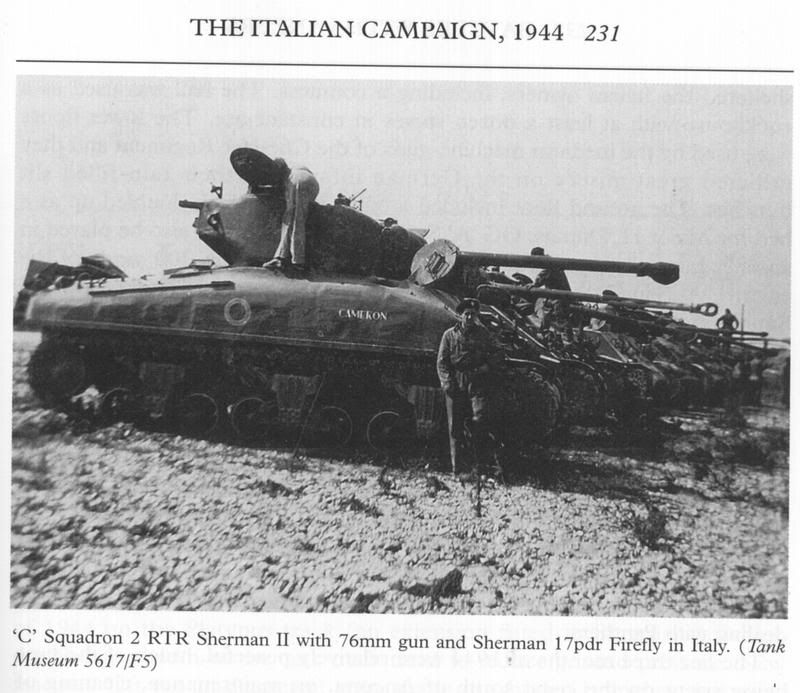
The Sherman II made its operational debut with 8th Army in the El Alamein battles.  The Sherman II had a cast hull and a petrol engine.  It was used by the British throughout Africa, into Tunisia and then on to Italy.  The M4A1 saw its debut with the US in Operation Torch and was used throughout the ETO from that point onwards.

(The 'Dry' hull / 'Wet' hull denotes the ammo protection.  The later 'wet' hull adds bigger hatches for escape and water protection around the ammo).

From Plastic Soldier Company
Okay, the PSC kit comes with the 75mm gun.  The 76mm and 105mm gun aren't used with this hull so we can put them in the bits box.  

For doing a Sherman M4A1 in US service from late '43 onwards (so mainland Italy and Normandy) we can take the model straight out of the box. The applique armour started appearing from summer '43.  Strictly there should be two extra plates in front of the driver and co-driver position (you can see them in the bow MG photo above).  They can be added quite easily with a bit of plasticard.  The cast one piece hull could be used for a later production example but the bolted three piece nose is more common early on.  Don't forget to add stowage!

For doing a 1942-early '43 Op Torch era Sherman we're going to need to file the applique armour off.  The appliqué armour was added to the 'dry' hull to add protection in the areas where ammo is stowed and this started to appear in the summer of 1943 as crews realised why they were brewing up (nothing to do with the petrol engine).
I'm thinking a Dremel should do the trick, working from the centre of each plate outwards.  Nose should be the three piece option (as shown on the CAD sculpt) and Sand Shields should be fitted.

The British Shermans are a bit trickier.  For the most part they will look like their US equivalent for the period but the Brits welded a round edged stowage bin onto the rear of the turret.  This is missing from the kit and will require a bit of plasti-card work to replicate.  I plan to do a full squadron of 16 tanks so the dremel and plasticard will be getting some heavy use.
Sherman II in North Africa.  Note stowage bin and lack of appliqué armour
This kit is pretty good out of the box.  It's used by the US mainly but the UK and other commonwealth/free armies (South Africa, Poland) did use them (2nd Armoured Brigade in Italy).  Looking around for photos, it looks like the UK didn't find any need to fit stowage bins.  Nose should be the cast one piece option (no three piece transmission covers where used on the late production).

From Plastic Soldier Company
The 76mm gun should be the only one fitted to this hull and will appear from mid 44 onwards in places like Normandy and then later in Italy (late 44).

M4A1 Sherman IIA (76mm Wet Hull) in UK service.
This version of the Sherman, a diesel powered welded hull, was used by the Lend-Lease forces (UK and USSR) and USMC.  It's also pretty similar in looks to the gasoline powered Sherman I (M4) and Sherman IV (M4A3), differing mostly in the engine deck detail, which gives it more utility for the US players.
From Plastic Soldier Company
The model uses the original 'dry' hull so strictly is only used with a 75mm gun and turret.

This variant made its debut with British forces in North Africa around about El Alamein.  It also appeared in large numbers with the Soviets.

A UK example pre-43 should have the Sand Shields on and the appliqué armour filed off.  It should have a stowage bin on the turret rear.  Late 43 (Italy and Normandy) then the appliqué armour can stay on.  Hopefully the scale will be good enough to allow it to be matched up with a Battlefront Sherman VC for a Normandy troop.

A USSR example should be fairly easy to achieve out of the box.  Factory fitted appliqué armour should be a feature of late-war ones as deliveries were made.  Initial deliveries should be reflected by filing applique armour off.  No Russian commander which is a shame but most Russian players probably have a bag of them spare anyway and they are easily sourced elsewhere. As mentioned, the hull is incorrect for a 76mm armed example, but given the number of tanks a Russian player needs to buy, I'd be inclined to turn a blind eye to that!

Finally, the US ones should follow similar lines to the UK, less stowage bins.  If being used as a stand in for a Sherman I (M4) in Operation Torch then the armour should be filed off.  Otherwise, your good to go.

Conclusion
So, out of the box, these kits are great for doing late 43 onwards example of the Shermans and I really recommend looking into them.  It would have been great if the appliqué armour had been left separate and a stowage box offered as an option but these are all fairly easy things to fix if your so inclined.  The vast majority of players will probably say a 'Sherman is a Sherman' and leave it at that which is fair enough.  But spending a bit of time getting the tank looking right for the period will pay dividends in terms of theming a force.

Now, all I need is some cash to buy three boxes of Sherman II for my desert army and some more plasti card!

Thursday, 7 July 2011

Flak-tastic - FlaK-36 on the limber

Hello,

Another short post this week whilst I'm in-between projects.  Hopefully next week I'll be under way with the A13 but this week has been a bit hectic.  Instead, lets take a look at one of my many 'work in progress' side projects, the fearsome FlaK 36 or "88"!

When I started my DAK force I knew I wanted a pair of these fearsome dual purpose guns in the force.  They've always struck fear into my 8th Army force with the gun able to pick off even Sherman II at long range with ease!

I wanted to have the 88 firing from the limber.  The carriage and trail of the 88 was quite ingenious.  Two, non-folding, legs of the cruciform trail form a spine to which wheel units are attached.  The way the carriage is designed allows the 88 to be fired from the carriage, albeit with a limited arc of fire.  Quite handy in the mobile warfare of the North African deserts.
Schnell!
The two remaining legs are hinged and fold down in action to form the rest of the cruciform trail.  The legs don't bend beyond 90°, so when firing from the carriage they sit sticking out quite awkwardly (as can be seen above).  A video I saw of an 88mm firing like that in Normandy appeared to show the 88 tipping over then bouncing off these feet to right itself (Here at 0:30).  Hairy stuff!  This site has some good pics of the 88 on its carriage.

The first thing I did was to form the base.  With all eight crew modelled, the 88 needs a lot of real estate and being mounted on the carriage makes the beast even bigger.  To get round this I planned to stick a FoW medium base to the back of the large base.

First I lined the bases up using a steel ruler turned on its side.
P1010659
Precision Engineering
I then glued plastic cut from a blister to bridge the gap, a strip on top and one on the bottom.  When I polyfiller the base later I will fill this in and sand down to hide the join.

Next I glued the wheels to the carriage units and the carriage units to the trail.  I also glued the gun to the pedestal leaving me with two main sub assemblies: the carriage and the gun.

Next I got the Dremel out and, using a 0.5mm drill bit, drilled holes in the legs, carriage and the base of the pedestal.  I then inserted lengths of the cable tie wire I mentioned alst week to form pins.  I kept the wire coming out the Pedestal fairly long to allow it to rotate in the carriage (and be removed to fit in the case, did I mention its big?) whilst still being stable.
P1010661
Pedestal and one Trail Arm drilled and wired.  Note also the plastic strip on the base.
Next I glued the arms to the carriage, guiding the wire into the mating hole I had drilled.
P1010662
An upturned 88mm.  Certainly a site that would make most allied tankees happy!
You can probably also see that I've drilled and pinned the wheels to go into holes in the base.  This is just to give the carriage a fair chance of staying stuck to the base in day to day use!

That leaves the 88 looking something like this:
P1010663
Arms down and ready to fire!
That pretty much gets the gun done (I'll add the wire spools and towing arm later).  The crew is the next to receive my attention.  Most of them will be one the base as per normal but I wanted one or two per gun to be on the carriage, loading.  Obviously the circular bases would not really bled in with the carriage so we need to get busy with the side cutters!
P1010739
"Atchung!"
Firstly, I cut off the majority of the base leaving just an area around the foot.
P1010740
Rough cuts
Next, I carefully cut away the material under the foot.  I find its best to err on the side of caution and file down an excess rather than try and rebuild a foot from scratch!
P1010741
"Do your worse!  I'll never talk!"

P1010743
Footloose and fancy free

Next, I use the trusty 'ol Dremel and pin the foot.
P1010744
Worse than standing on Lego

It's then just a case of drilling a corresponding hole on the Carriage.  Obviously I'd recommend doing a dry run with some blu tac first to work out the narrative of the base (who's where and who's doing what) rather than leaving the carriage looking like Swiss cheese from aborted drilling runs!
P1010745
Earning that Rate of Fire of 3!
P1010664
A fully kitted out Jerry super weapon (shortly before the 25pdr got the rotter!"
So there we go.  Two 88 ready for painting and then a visit to the table top to terrorize some Englanders!
P1010746
Well, I make that six dead Grants...
That's it for this week.  Hopefully Everest will have my hot glue gun for em and I can prep the A13 Cruisers next week.  See you then.

Tuesday, 28 June 2011

Aerial Warfare

Hello!

Firstly, thanks to the guys over at "All Along the Watchtower" for the shout out and kind words.  Keep up the hard work guys!

Okay, just a small update this week.  I'm going to take a quick look at fitting tanks out with aerials.  It's a small detail that often takes mere seconds to do but really adds to the look of the tank.  These days I fit out all of my AFV (and some of my soft skins) with aerials.  There really is little reason not to!

Two aerials for extra bling - maybe
Research
First stage as ever is research.  The time spent flicking through reference books and conducting web searches is rarely ill spent and can pay dividends.  Whilst conducting research the following questions should be in the back of your mind:

  1. Where are the aerials located?
  2. Where they always fitted?
  3. If multiple aerials are present, are they the same length?
The exact answers will largely depend on the tank, its role in the platoon and what in the war your at.  For example and Early Russian T-34 may not have a radio!  Photos of tanks are especially handy although aerials are sometimes difficult to make out.  museum tanks often don't have them fitted.  hyper modeller sites can prove useful but try and verify they are doing it right! Most models, certainly in the Battlefront range at least, will also have the aerial mounts cast in to be used.
P1010728
Left one should always be present.  Right one should only be present on the Troop Target, I mean Commander 

As an example, I researched the Sherman V (again, having already done this before).
The Sherman has two radio aerial positions:

  • One on the hull behind the commander cupola
  • One on the left rear opposite it.  
  • Incidentally there is a third mount on the lower hull near the assistant driver's position.  Never seen it populated with a radio mast though in any pictures.

Now, photos on the net and in my books generally show the left (i.e. not the one behind the commander) one populated with an aerial.  A cut away in another book answers why; it shows a radio on the left side, no doubt manned by the Loader fir short range troop communications.  The right hand one is for a Troop/Squadron Commander to have a long range second radio set for communications in the wider world (squadron net).
P1010736
From "The Great Tanks" by Chris Ellis and Peter Chamberlin - used without any permission whatsoever

Generally, British and American tanks have the loader man the radio. So an American tank will have the radio and aerial on the left and British WWII tanks will have it on the right (I have no idea why we have the loader on the opposite side during WWII - it appears to standardise on the american methodology postwar).

Setting the Radio Up
Now we've worked out where we're putting the aerial we need to get on and fit it!  I've used one of my A13 I'm working on as an example.

First, clean up the aerial position.
P1010729
No doubt not the only knob on the tank...

Now, get a 0.5mm drill bit
P1010730
definitely not compensating

Put it in a Dremel or Pin Vice depending on your tool of choice. And drill baby, drill!
P1010731
There is a slight alignment issue in this staged shot.

Now to find a suitable aerial.  I used to use sandwich bag ties.  This is think gauge wire wrapped in plastic/paper.  Just strip that outer off and you have a thin metal aerial ready to go (also good for pinning).  It's a bit thick but it can be molded to shape.  the big issues is that paint does tend to flake off and it can be an arse to fit into a figure case.
P1010732
The most boring photo I've ever put on this blog?  Quite possibly!

I've switch over to Brush bristles.  What I do is get a decent synthetic hair decoraters brush and take a few bristles off.  A little goes a long way.  This brush populated my BEF army and then got used to paint my brother's flat!
P1010733
Hopefully my brother never reads my boring geek blog to find out what I've been doing with his brushes...


No matter which method you use, dip one end in some superglue and put into place.  Trim to size and paint black to finish off!
P1010734
Job Done!

So, there you go.  See you all next week!

Wednesday, 22 June 2011

Laying Down Some Dirty Tracks (and other weathering techniques)

Hello,

As promised, we're going to look at the final steps to completion on the Vickers Light Tank Mk VIb, after I managed to avoid buying into Dystopian Wars for at least another pay day.  These stages are mainly related to weathering and markings.

By this stage I've already incorporated some weathering (the streaking of the paint) and detail work (the Vision Blocks and Search Light), so that leaves:
  • Tracks (rust and dirt) and Guns
  • Exhaust (red oxide finish and soot marks)
  • Unit markings
  • Hull Dirt
Firstly, the tracks and muzzle of the guns are blacked out (actually done at the same time as marking out the vision blocks and search light in black).  This gives a good base for the following stages.

Next, I mixed Vallejo 'German Grey' and 'Gunmetal' in a 50:50 ratio and covered the muzzle, just leaving a small line of black where it joined the gun cowling.  I then painted over this in 'Gunmetal' before painting the very edge in 'Oily Steel' for a highlight.

The Tracks were dry brushed in 'Gunmetal' and washed in 'Black Shade'.   This gets them to their natural state as it were.

Next, I covered the exhaust in 'Flat Brown' to give a base for the 'red oxide' finished exhaust that period tanks seem to have.
P1010612
Does Kwik Fit have an Exhaust for a 1939 model Vickers VI?
I then applied a highlight of 'Red Leather'  On the most recent batch of Vickers (the ones I'm currently working on) I actually applied some mottles of 'Red Leather' to give a more 'uneven weathering' look to the exhaust.  
I also applied a wash of 'Red Leather' to the tracks and suspension to give the impression of localised surface rust on areas likely to be soaked by river fording and use on wet ground. 
P1010721
It's a bit rusty.  Time for some Hammerite!
I also experimented with using the watered down 'Red Leather' to give the impression of rust streaks.  This appeared to give the right look but I decided to not apply it to the BEF tanks.  They just didn't survive long enough to get rusty!  One to save for a Late war Sherman army (especially the run down Shermans 3RTR received in the rush to reinforce the Ardennes in the Battle of the Bulge).
P1010722
Rumours that the dust streaks are experimentation for Dystopian Wars are vastly exaggerated...
Finally I stippled on some black paint to give a soot smudge effect.  I found the best way to do this was in two stages.  The first was to stipple on wet black paint using an old dry brush.  I then semi-dry brushed on black paint to get the main smudge.  I think it gives a nice impression of the soot that would build up near the exhaust over time.
P1010721 - Copy
It looks good now.  But the RSM is going to make them clean it off with toothbrushes later...
I needed to get the markings on next so that the dirt wash would go over the top.  It's important to get the narrative of the weathering correct.  Having markings over weather sticks out like a saw thumb (unless its a deliberate re-marking late in a vehicles life).  Other effects need some thought given to circumstances.  Similarly the dirt should go over rust as the rust is even more in grained than this mornings run through a stream but dust over or under an oil stain may be equally applicable.

For reference Armoured Acorn lists the markings for various tanks used in 1940 France and 3RTR is well represented on all marks, including The Vickers IVB.

As with all my projects, I did markings free hand rather than use Transfers.  Transfers and me never seem to get on well.  I use a GW Standard Brush (fat enough to carry paint but a fine point to give a decent line) and the paint thinned down slightly more than normal.  The markings are as follows:
1.  Bridge rating - 'Deep Yellow' circle with 'Black' No. 6 in centre.  Located only on front hull.
2.  Arm of Service Marking - Green square (50:50 mix of 'Luftwaffe Cam. Green' and 'Yellow Green') with 'White' No.9 in centre.  This is on the centre of the front hull and the rear board.
3.  1st Armoured Division symbol - A White Rhino within a white outline oval.  I painted an oval first and then two overlapping teardrops to give a rough rhino body shape).  Looks okay!  This is only on the front hull.
4.  Squadron Marking - A Yellow Triangle for 'A' Squadron.  This is on each side of the turret with a small marking on the turret front unfortuantely unable to fit due to the way the Search Light is modelled not leaving enough space.

With the markings applied I watered some 'US Field Drab' down to a wash and applied it liberally over the lover half of the tanks and carefully along areas where dirty was likely to gather as water evaporated off (the front hull strakes, the rear bin, around hatches - no doubt carried by dirty boots.

This completed the Vickers Light Tanks.  Here are some shots of the finished tanks.
P1010622
Vickers IVB of A Sqdn 3RTR, 1st Armd Div

P1010627
Troop Commander - Front (yes, I bodged the '6' up on his tank to the extent it looks like a sigma!)

P1010624
Left Side of Troop Commander

P1010625
Backside (huh huh) of Troop Commander

P1010628
Top Surface

P1010606
The Troop Commander!  Like I said, we'll look at painting the commander and other infantry in the future

So there you go!  First Troop done, seven more to go.  Plus Dingo.  Plus Infantry.

Whimper...

Tuesday, 14 June 2011

G3 Khaki Green - Or "WTF? Are we camouflaging this for a Disco?"

Hello

There is always one peril with historical wargaming.  Having someone in the past do something stupid with no regard for how it will affect generations of players later!  Sadly, playing Brits in WWII one tends to run into them far too often but it does build character.

BEF Tank camo, specifically for the Armoured Divisions, is one of these areas.  Seriously, luminous green as a tank camo?  I'm not sure if this is Battlefront making a bad call, there are a few colour charts that agree with the colour choice, but what the hell is going on with Cruiser Green?  Did someone think there was rain forests in the Belgium?  Did they let the raver mix the paint and he dropped some glow sticks in?  What was going on?  sadly this is the same military that came up with the wonderful idea of not bothering with a HE round  for the main gun...

Research
Needless to say, I was going to stray a little away from reality here and it doesn't seem to be too uncommon.  Looking around I found a few examples that don't seem to agree with the colours in 'Blitzkrieg'.  This model of a 3RTR A13 on Missing Lynx shows something that looks closer to Russian Uniform and the Bovington Tanks (I found some photos here and here) concur.  It's always dangerous relaying on museum tanks, often they are repainted in.. interesting interpretations of the original colours but it was a straw I could grab onto!
Interestingly Phil Yates, one of the BF rules monkey's (if not *the* head rule monkey) also went with Russian Uniform.  He put his thoughts in two articles (here and here) and also in the forum and certainly guided me in my choices when it came to the paint job.

Execution
Now, I had a 'brainwave' when it came to painting up the BEF quickly.  Quoting myself
"I'm opting for base coating with US Armour spray coat (basically Brown Violet) then...masking and spraying over with British Armour spray to get the same effect."
Yeah...  That didn't work out too well.  The issue was the mask.  I sprayed the model using Army Painter/Battlefront "US Armour" and then used the liquid mask that comes in the Vallejo/Battlefront utility set.  Firstly, this stuff destroys brushes!  It dries on the brush whilst your applying the mask, even washing the brush in-between areas didn't help.  You also can't over mask an area that is already masked as it tends to lift.
P1010581
Brown Violet - Not particularly violet but versatile none the less!

DSC05046
"Mask!"  Not Mobile Armoured Strike Kommand
I eventually got the model masked off, cheating by using blue-tac to hide the tracks so that the lower hull would be in the original colour, and decided that I would proceed with just one Vickers tank until I knew if it worked.  That was probably the only good call of the day!  I sprayed the "British Armour" spray and left it dry overnight.
DSC05048
Bright green - not luminous green!

Removing the mask was a complete bitch.  Trying to lift the mask off with tweezers scratched the Brown Violet paint below and I really had to dig it out, using a cocktail stick, from the various nooks and crannies.  I easily spent 30 minutes to an hour trying to do this and still had masking present!

P1010609
Note scratches and little scraps of liquid mask gripping for dear life around smoke dispenser

P1010608
More scraps stuck around searchlight and gun mantle.  Scratches near exhaust.

I eventually admitted defeat and put the model aside for stripping (I'll cover that process at a later date).  I then decided to paint it by hand instead.

Execution Take II!
So, three more Vickers undercoated in 'US Armour'.  This time I decided to highlight the Olive Drab before laying down the lighter green as I was worried about trying to drubrush the camo without straying onto the lighter colour.
So, I grabbed a large flat drubrush and did a heavy drybrush of Vallejo 'Brown Violet' (the paint is slightly lighter than the spray) followed by a lighter drybrush of Vallejo 'Khaki'.

That done, I then painted on Vallejo 'Russian Uniform in broad irregular strips aiming to cover 2/3rds of the model and carrying the pattern over the turret aligned forward.  I left the paint off the lowest surface of the front and rear plates, on the gun cowls and below the track guards.  These are areas that Phil Yate's research suggested would be 'skipped' by the crews when they repainted as they were a bugger to paint.  Makes sense.
P1010583
Makes you wonder why I bothered painting the Olive Drab seeming as I covered most of it!

I then mixed in 'Tan Yellow' to provide a light, bright highlight.  I used a smaller flat drybrush and carefully applied it to the Russian Uniform areas, trying to avoid the Brown Violet patches.
P1010584
Perhaps a bit pale.  May try adding some Yellow Green next time.
Next, I did my normal wash stage.  I made a 50:50 mix of Vallejo 'Black' and 'Brown' washes then watered down.  I used a GW Standard Brush (the orange tipped one) to carefully apply the wash to panel edges, around detail and the rivets.
P1010586
The Troop after washing
That gets the basic armour done. I applied some weathering at this stage in the form of rain and UV lines but I'll cover this next week.

I marked the vision blocks and lights out in black.  The vision blocks had Luftwaffe Uniform applied and a tiny dot of white in the corner.  A very simple 'glass reflecting sky' look.  The search lights were picked out by painting a hemisphere of 'Gunmetal' on the lower half of the black disc.
P1010614
"I can clearly see now/the vision slot is painted"

Then an 'Oily Steel' arc on the 'Gunmetal'
P1010615
Oily Steel sounds like it should be a porn name.
Then a thin line and a dot of white to complete.
P1010617
"and lo.  The Commander said, let there be light"
You'll note that I've ignored the Commander.  I tried a different technique on him and we'll revisit this on a later blog.

We'll leave it there for this week.  Next week I'll pick up on tracks, markings and weathering to completion.

Finally, a quick plug for the chaps over at "All Along the Watchtower" podcast who have launched a forum.  It's quite a diverse group with forum members from outside of Brighton and is also home to forum exclusive content.  Give it a try!

Enjoy.